
THE VERDICT
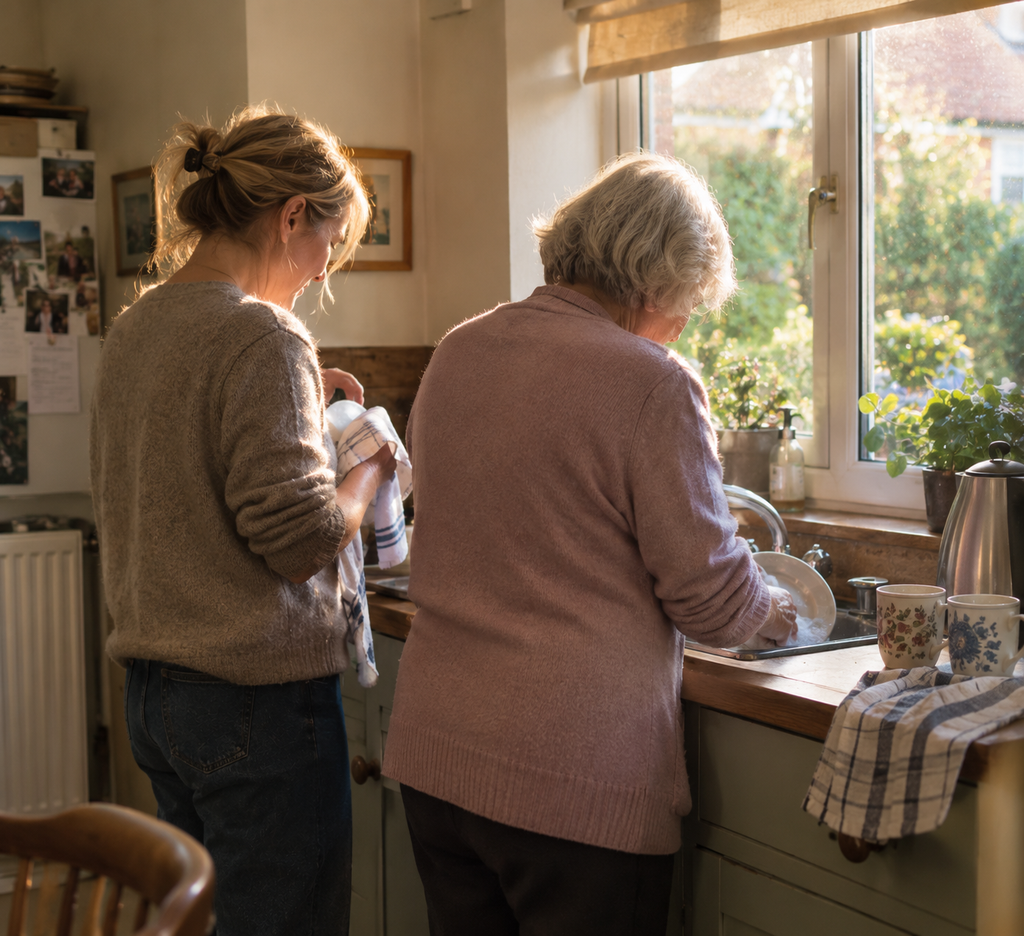
You’ve been rehearsing it since you left the house. Forty minutes of practising one sentence in the car: softening it, sharpening it, softening it again.
Then Sunday lunch happens. Mum is sitting while you carve (you noticed that last time too) and you say it as gently as you know how.
“Mum, have you ever thought about getting a bit of help?”
The room doesn’t go quiet. It goes polite, which is worse.
“I’m managing perfectly well, thank you,” she says, and stands up to clear plates nobody has finished.
And that’s that. You drive home with the speech still intact and the problem exactly where you left it.
WHAT SHE ACTUALLY HEARD
You said “a bit of help”. She heard a verdict. For someone who has run a home and a family on her own terms, “help” is not a neutral word. It lands as: You’ve noticed. You think I’m failing. And a few steps behind it comes the thought nobody says out loud: this is how it starts. Help, then a carer, then a home.
So she does what proud people do. She protects the one thing she still fully controls, which is the answer. “I’m managing” isn’t information. It’s armour.
THE WORDS THAT CLOSE THE DOOR
Some lines feel loving when you say them and land very differently.
“You can’t carry on like this.” It’s a verdict again, this time from her own child. Nobody in history has replied to a verdict with “good point”.
“We’ve been talking, and we think…” Who’s “we”?
The moment she learns there has been a meeting about her without her, the conversation stops being about help and starts being about betrayal.
Raising it at a family birthday, in front of everyone. Not a sentence but it does the same damage. Nobody agrees to be assessed with an audience and a trifle.
THE WORDS THAT OPEN IT
The pattern is simple: they start with her, not with the problem. Say them side by side, washing up or driving, when nobody has to hold eye contact.
• “What’s the most annoying part of your week at the moment?” Annoying lets her complain without admitting anything, and people will tell you a lot once complaining is allowed.
• “What do you want to keep doing yourself, whatever happens?” This is the big one. It tells her you’re not here to take things away. Her answer (the garden, her own front door, choosing her own clothes) is exactly what good support should protect.
• “It would help me, honestly. I’d sleep better.” You’re not diagnosing her, you’re asking a favour. Plenty of parents who can’t accept help for themselves will accept it as a gift to their child.
• “Could we try it for a few weeks, and then you tell me honestly if it earned its place?” A trial isn’t surrender. She stays the judge.
• “Nothing gets decided today.” Say it early. Watch her shoulders drop.
THE FIRST ANSWER WILL PROBABLY BE NO
That’s allowed. A no on Sunday often becomes a “well, maybe” by Thursday, once she’s had time to turn it over by herself.
Think of the first conversation as planting something, not winning something. If you win the argument, you’ve lost her.
Leave the door open: “Okay, I won’t push. Can I ask again in a few weeks?” Then genuinely let it rest.
THE CONVERSATION YOU DON’T WANT IS THE ONE YOU HAVE LATER
Families who wait for the right moment often find it chosen for them: a fall, a hospital stay, a phone call at 2am.
Then the conversation happens in a corridor, in a hurry, with fewer options and more fear. Decisions made under pressure tend to be bigger, faster and less hers.
The gentle, slightly clumsy conversation now is a kindness. It’s the one that keeps her in charge.
WHAT IT CAN LOOK LIKE WHEN IT GOES WELL
A few months on, Mum has agreed, “just to stop you going on”, to a trial: someone calls in on Tuesday and Friday mornings to help with getting washed and dressed and a proper breakfast.
She spent the first visit supervising. By the third week she was mentioning the carer by name. By the sixth she was saving her the good biscuits.
She’s still in her own house, still making her own tea, still the boss of her own day. Nothing was taken from her. Something was added.
That’s what good support is meant to be: not the start of losing independence, but the very thing that helps you keep it. Independence, supported.
STUCK AT THE CONVERSATION?
Maybe you’ve rehearsed it and still haven’t said it. That’s normal.
If it would help, talk to us first. We can explain what a first visit really involves, help you find words that suit your family and if your parent is open to it, have a relaxed chat with them directly. No commitment.
She probably won’t say yes to “care”. She might say yes to Tuesday morning, someone to do the heavy bits, and a trial to see how it goes.
Start there.